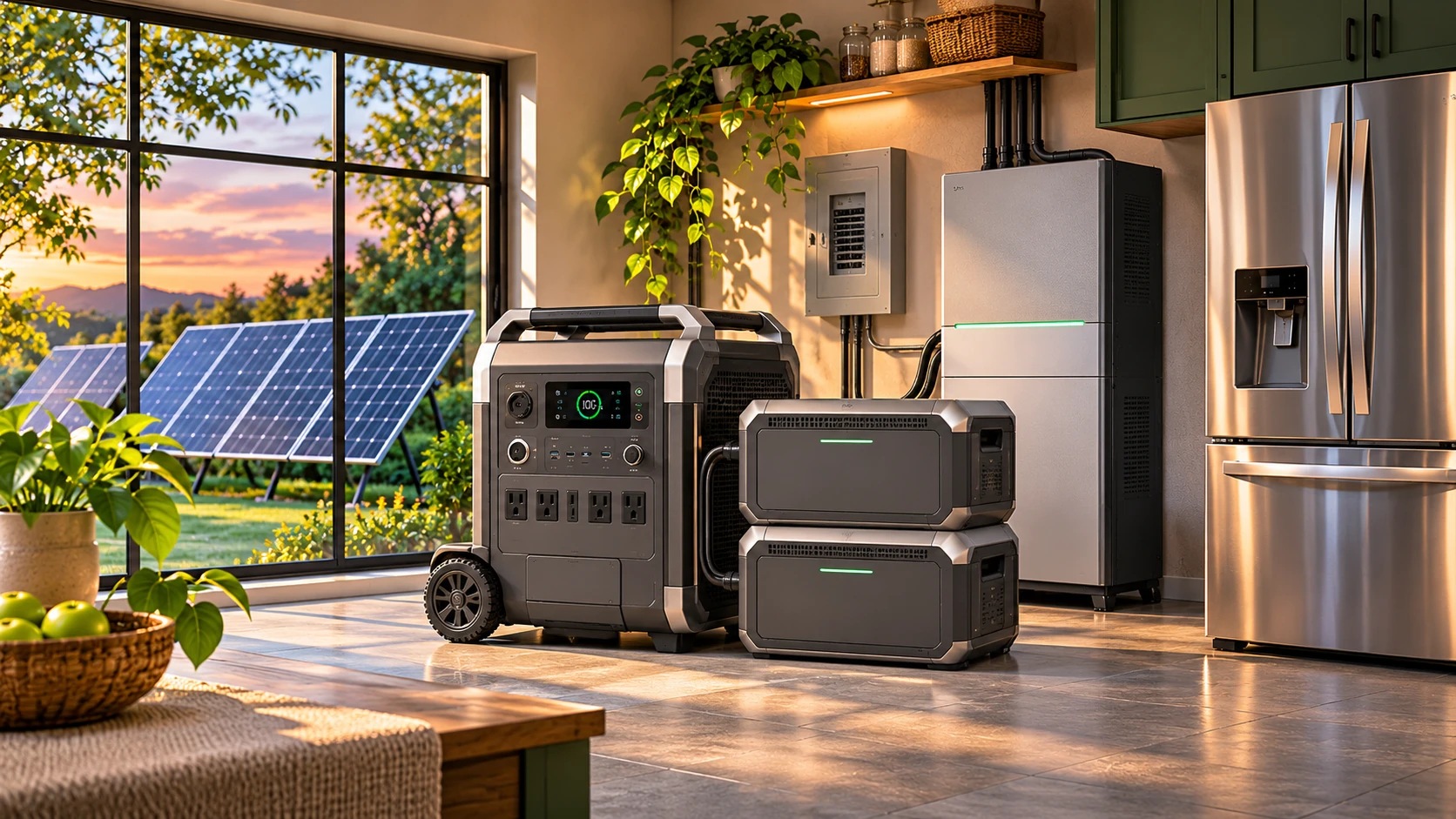
How bundle capacity is calculated
Bundle capacity is the sum of the host station's rated battery capacity and each compatible expansion battery. For example, one 5,040Wh station plus one 5,040Wh battery pack equals 10,080Wh (10.08kWh). We show the host unit capacity and the configured bundle capacity separately so readers do not mistake an expandable maximum for what is included in the box.
Portable bundle examples
- Jackery Explorer 5000 Plus: one 5,040Wh station plus one matching 5,040Wh battery pack = 10.08kWh; manufacturer lists 120/240V output and a 7,200W total AC output maximum.
- Anker SOLIX F3800 Plus: 3,840Wh host plus two 3,840Wh BP3800 packs = 11.52kWh. Manufacturer documents 120/240V output at its L14-30 port.
- OUPES Guardian 6000 V2: 4,608Wh base plus two 4,608Wh G5 packs = 13.824kWh. Manufacturer lists 6,000W at 240V and 3,600W at 120V.
- EcoFlow DELTA Pro Ultra: one inverter plus two 6,144Wh batteries = 12.288kWh; manufacturer lists 7,200W at 120/240V.
Residential energy-storage systems are a different category
Anker SOLIX E10, BLUETTI EP800/EP900 and EcoFlow DELTA Pro Ultra X are better treated as home-backup systems, not lightweight portable stations. They can provide larger split-phase output and higher PV input, but installation, transfer equipment, permitting and local electrical requirements matter.
Do not confuse capacity with output
Battery storage is measured in Wh or kWh. Inverter output is measured in W or kW. A 12kWh battery can still have a 6kW, 7.2kW or 12kW output limit depending on the inverter. The right system must meet both your energy-duration and instantaneous-load needs.
Use an approved transfer method
Never feed a household panel through an improvised cable or backfeed a wall outlet. Use the manufacturer's compatible transfer switch, inlet box or home power panel, and a qualified electrician where household wiring is involved.
Compare bundle specifications →